
LUNCHTIME RECITAL
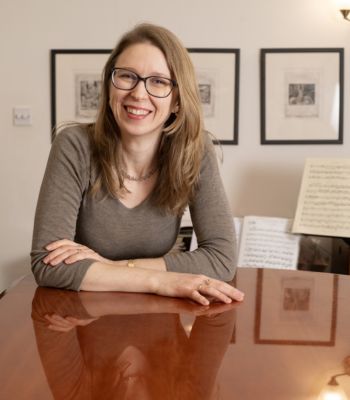
Dr Elena Vorotko – piano
FREE ADMITTANCE
Retiring Collection

The Programme
Dr Elena Vorotko – piano
Johann Sebastian BachPartita No 1 in B♭ Major, BWV 825
i. Praeludium
ii. Allemande
iii. Corrente
iv. Sarabande
v. Menuet I–II–I
vi. Gigue
Sonata in C minor, Op 13 (Pathétique)
I. Grave – Allegro di molto e con brio
II. Adagio cantabile
III. Rondo: Allegro
Impromptus, Op 90, D899
No. 3 Andante
No. 2 Allegro
The Artist
Elena Vorotko started her performing career at the age of nine, and by winning regional piano competitions and performing at festivals in Russia and touring Europe. Elena was first taught by her mother and then studied with Natalia Fish at the Central Music School in Nizhny Novgorod, Russia. At 16 she entered the Purcell School of Music in Hertfordshire on a full scholarship to study with Tatiana Sarkissova, and in 1999 she received a scholarship to the Royal Academy of Music to learn with Professor Christopher Elton. She was also mentored by Boris Berman, Alexander Satz, Kenneth Gilbert, Malcolm Bilson, Pierre-Laurent Aimard, Menno Van Delft, Paul Badura-Skoda and Noretta Conci.
She won the Alfred Brendel Award, Harriet Cohen Bach Prize, ORSAS grant and MBF Music Education Award. One of the highlights of her career was a performance for HRH Prince Charles. She made her South Bank debut in January 2006 as a Park Lane Group Young Artist with a critically acclaimed recital recorded by BBC Radio 3, and later that year won the Third Prize at the XV International J S Bach Competition, Leipzig. She has since performed in London’s major venues, such as Queen Elizabeth Hall, St Martin-in-the-Fields, Cadogan Hall and St John’s, Smith Square. She was promoted by the Keyboard Charitable Trust to perform in the UK, Germany, Mexico, Italy and the US. In 2010 she was awarded a PhD from London University in the performance practice of J S Bach. She now presents public lectures at the RAM Museum as an Honorary Research Fellow and works as an Artistic Director and a Trustee of the Keyboard Charitable Trust.
‘Vorotko’s range of tonal colour was enormous, as were the intense swings in emotional content – achieved through sheer technical virtuosity and an iron grip on dynamics and phrasing.’ – Musical Source